Solve the Case How to Play / Getting Started
Unbox the suitcase, learn the lockout rule, and start Play 1 the right way.
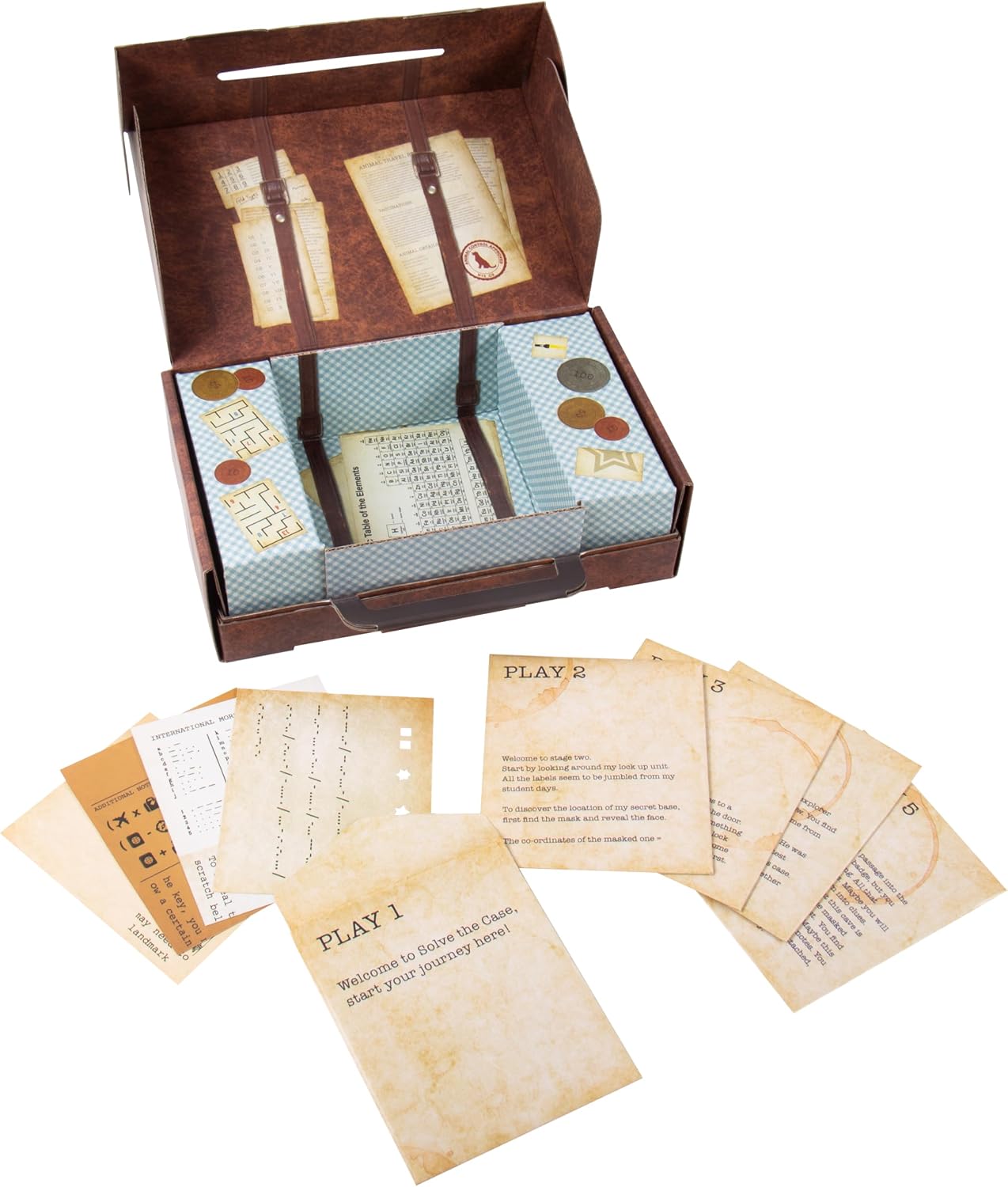
Solve the Case packs a five-chapter escape room into a travel suitcase. Fizz Creations designed it for ages 12+, one or more players sharing a single physical case, and roughly an hour (or more) per Play. This guide is the rules-first overview: what is in the box, how setup works, how answers are checked, and how to avoid spoiling later chapters. Full puzzle solutions live on the Play walkthrough pages linked below.
What you get
Inside the vintage-style case you should find:
- Five sealed Play envelopes (each with about 4–6 cards)
- An instruction sheet
- An answer sheet (keep it closed until you need to verify a final answer)
The case itself is part of the puzzle space. Stickers, locks, scratch areas, mazes, and printed artwork matter. Treat the suitcase as a board, not only as packaging.
Story hook (spoiler-light)
Airport security discovers a leather case covered in travel stickers. Someone needs the case returned to its owner. Across five Plays you decode documents, foldables, codes, and case interactions that reveal where the luggage has been—and who should receive it. You do not need the full lore up front; each envelope advances the narrative when you are ready.
Setup checklist
- Clear a table large enough for the open case plus card spreads.
- Open the case and keep it within reach for the whole session.
- Remove Play 1 only. Set Plays 2–5 aside, still sealed.
- Do not open later envelopes early. Order is mandatory: 1 → 2 → 3 → 4 → 5.
- Keep completed Play materials. Later chapters reuse earlier reveals and case codes.
- Decide who may consult the answer sheet. Official rules: choose one player to check a final answer. A wrong check locks that player out of the current Play; they rejoin on the next Play.
How a Play works
Each envelope front shows the Play number. Inside you will find task cards, clue cards, and sometimes story flavor that is not immediately actionable. Some items feel useless until a later step—or they are red herrings. That ambiguity is intentional.
Typical loop:
- Read the active cards carefully (both sides when relevant).
- Compare card cutouts, codes, and diagrams to matching features on the case.
- Combine information until you have a candidate final answer for that Play.
- Have your designated checker verify on the answer sheet.
- Only then open the next envelope.
Hints sit on the back bottom of each envelope. Use them before jumping to a full walkthrough if you want to stay closer to the intended difficulty.
Solo vs group
One person can complete every Play alone. Groups share the same suitcase—this is local co-op around one object, not online multiplayer. In a group, assign roles: reader, case handler, note taker, and answer checker. Rotate the checker so one wrong guess does not sideline the same person repeatedly. For seating ideas and group dynamics, see Solo & Group Tips.
Difficulty expectations
Plays escalate in interlocking complexity more than raw “IQ.” Early Plays teach you to trust the case as a tool. Mid Plays add ciphers, folds, and multi-step numeric work. Later Plays lean on prior answers and denser deduction. Our Difficulty Tier List ranks relative toughness; community consensus often flags Play 4’s coin interaction as the most confusing step in the product.
When to use this wiki
- Rules confusion → stay on this page and Tips & Hints.
- Stuck on a specific chapter → open that Play’s walkthrough only after a real attempt:
- Buying / product context → Where to Buy and Updates.
Common beginner mistakes
Opening every envelope at once. That ruins sequencing and can leak answers printed on later cards.
Throwing away or reshuffling completed Plays. Keep a neat stack; Play 3 and beyond explicitly lean on earlier case codes and notes.
Letting everyone peek at the answer sheet. The lockout rule is part of the tension. Protect the sheet.
Ignoring the case exterior. Scratch panels, locks, and sticker zones are not decoration.
Skipping envelope hints and going straight to video. Official videos are excellent when you are truly stuck, but envelope hints usually nudge without full spoilers.
Session planning
A popular cadence is one Play per evening (date night or family night). Competitive groups sometimes chain two Plays. Budget buffer time for folds and for re-reading cards after a dead end. If energy drops, stop at a clean Play boundary rather than half-solving the next envelope.
Accessibility and table comfort
Good lighting helps with small print, scratch reveals, and coin dots. A phone torch is fine. Keep drinks away from scratch surfaces and fold cards. If anyone is sensitive to “gotcha” puzzles, agree in advance that the table can take a collective hint break without shame—especially on Play 4.
Ready for Play 1?
When the table is set, only Play 1 is open, and everyone understands the lockout rule, start the first envelope. If you need a guided path with spoilers labeled clearly, continue to the Play 1 Walkthrough. For a visual overview of the product fantasy before you dig in, the trailer below shows the suitcase concept from Fizz Creations.
Browse every guide from the Guides Hub whenever you need to jump between chapters.
Frequently Asked Questions
Quick answers for detectives stuck on the case.
Can I play the five Plays in any order?
No. You must complete them numerically from Play 1 to Play 5. Later Plays expect you to keep earlier materials.
What happens if we submit a wrong final answer?
The player who checked the answer sheet is locked out of the current Play. Remaining players continue. The locked player rejoins on the next Play.
Where are the official hints?
On the back bottom of each Play envelope. Use those before opening the answer sheet or a full walkthrough.
Can one person finish the suitcase alone?
Yes. The box supports 1+ players sharing one physical case. Solo detectives handle every puzzle; groups usually assign one person to check the answer sheet.
How long is one Play?
About 60 minutes or more, depending on group size and how often you use hints.