Solve the Case Players Hub
How to share one escape-room suitcase—solo, couple, or full family table.
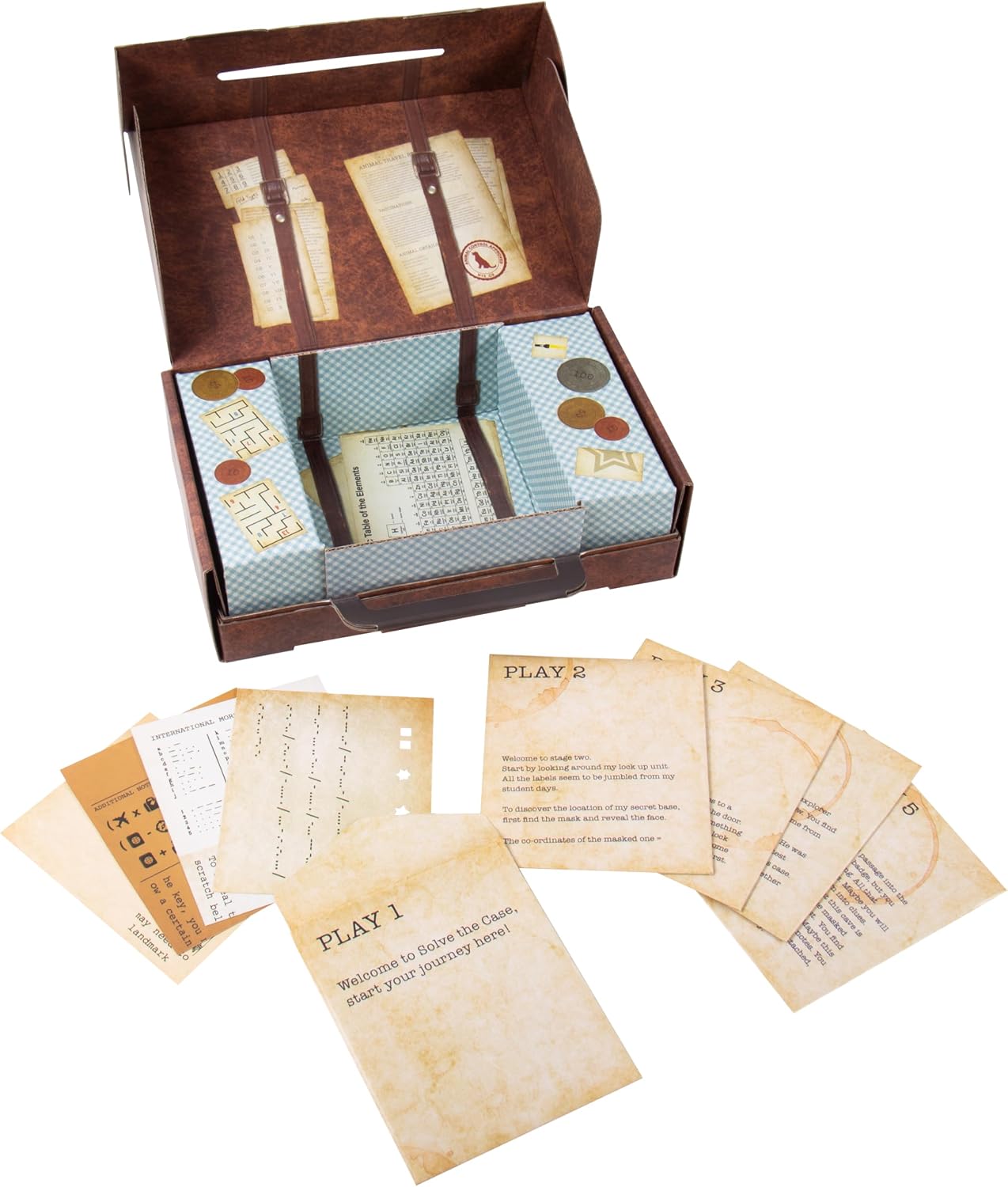
Solve the Case is built for people gathered around a single portable suitcase, not for online lobbies or remote co-op. The box lists 1+ players, ages 12+, and about sixty minutes per play across five sequential envelopes. You can run it alone at the kitchen table or pack a living room with relatives—the hardware does not change. What changes is how you talk, who touches the case, and how you protect unopened envelopes.
This hub covers player counts, practical roles, age and accessibility notes, and communication habits that keep the mystery fun. For a full evening plan aimed at couples or households, continue to Family & Date Night. For difficulty expectations per play, see the Difficulty Tier List. Setup and first-session basics live in Getting Started.
Solo investigation
Playing alone is completely valid. You control the timer, the note sheet, and every card flip. Advantages: no debates, full immersion in the lost-luggage story, and freedom to pause mid-play if dinner interrupts. Challenges: you must track spatial alignments and arithmetic without a second pair of eyes, and it is easier to accidentally glance at a later envelope when you are stuck.
Solo tips:
- Clear a wide surface so the open suitcase, current cards, and scrap paper never overlap.
- Speak hypotheses out loud or write them—externalizing thoughts replaces table talk.
- Set a soft midpoint alarm (for example at 30 minutes) to decide whether to take an official hint.
- Photograph tidy card layouts before you reshuffle, especially on multi-step plays.
When you need structured help, prefer Tips and Hints before opening a full play walkthrough.
Couples and small groups
Two to four people is the sweet spot for many households. Everyone can see the suitcase, hear every clue, and still have a job. Larger parties work if you rotate who sits in the “hot seats” nearest the case and let others act as researchers on scrap paper.
Agree before Play 1:
- No spoilers from phones unless the group votes to look something up.
- One official reader for each new card so information arrives in order.
- Envelope discipline—only the current play’s packet is on the table; future plays stay sealed and set aside as the instructions require.
- Keep finished plays—later scenarios reuse earlier material.
Recommended roles
Roles beat free-for-all grabbing. Swap jobs between plays so nobody is stuck as permanent scribe.
| Role | Job |
|---|---|
| Suitcase lead | Opens panels, aligns 3D pieces, handles stickers and scratch areas carefully |
| Card reader | Reads text aloud once, then passes cards for inspection |
| Scribe | Writes codes, partial answers, and “tried already” dead ends |
| Answer-checker | Compares proposed solutions to the answer sheet only when the group agrees |
| Timer keeper | Watches the sixty-minute clock and calls midpoint check-ins |
The answer-checker should not hover over the sealed solutions. Their job is to confirm a team consensus, not to peek early. If you are using this wiki’s walkthroughs, treat those pages like the answer sheet: labeled spoilers only after a table vote.
Age guidance and mixed tables
The printed recommendation is 12+. Younger puzzle fans can still join with an adult partner who handles fiddly folds, tiny text, and any scratch-off moments. Teens often excel at cipher and logic plays; adults may lead on careful case handling. For very mixed ages:
- Let younger players propose ideas first on visual puzzles.
- Keep Play 4’s tougher orientation steps from becoming a shut-out—invite everyone to test a theory on paper before rotating the prop.
- End the night on a success if possible; pause between plays rather than forcing all five in one sitting when attention fades.
Communication habits that help
- Narrate what you touch. “I’m flipping the fuse-box card” prevents double work.
- Park discarded theories on the scribe sheet instead of re-arguing them every five minutes.
- Separate observation from conclusion. “I see four stars” is safer than “the code is obviously…”
- Vote on hints. Frustration is contagious; a planned hint feels better than a silent phone search.
Avoid framing the product as online multiplayer or as “solo only.” It is local shared play around one object—flexible headcount, shared attention.
Accessibility and comfort
- Improve lighting; sticker art and fine print punish dim rooms.
- Offer a phone magnifier for small icons without opening spoiler sites.
- Allow breaks without stopping the narrative cold—pause the timer if your house rules allow.
- Keep snacks away from scratch areas and cardboard mechanisms.
Where to go next
- Plan the social format: Family & Date Night.
- Check relative difficulty: Difficulty Tier List.
- Prep tools and table setup: Tools Hub.
- Follow each envelope: Play 1, Play 2, Play 3, Play 4, Play 5.
- Browse every guide from the Guides Hub.
- Buying and official links: Where to Buy & Links.
Healthy player culture—clear roles, sealed envelopes, kind hint timing—matters as much as cracking any single code on the suitcase.
Frequently Asked Questions
Quick answers for detectives stuck on the case.
Can one person finish Solve the Case alone?
Yes. The game supports 1+ players around one suitcase. Solo runs work well if you keep notes, protect unopened envelopes, and give yourself permission to use hints when stuck.
Is this a networked or Roblox experience?
No. Solve the Case is a physical Fizz Creations suitcase for local shared play around one case. Everyone sits in the same room; there is no remote lobby.
How many people can reasonably share the suitcase?
Two to four keeps sight lines clear. Larger groups can rotate hot seats and assign off-table research roles so not everyone crowds the cardboard case at once.
Who should hold the answer sheet?
Pick a dedicated answer-checker who only opens solutions after a group vote. That role prevents accidental spoilers and keeps competitive tension healthy.